Most underperforming Meta ad accounts don’t have a targeting problem. They have a creative problem that everyone keeps trying to solve with targeting.
That shift has been building for a few years and is now hard to ignore. Meta has pushed advertisers toward broader audiences, automated placements and more algorithm-led delivery. The platform has more freedom to decide who sees an ad. Advertisers have more control over what those people see.
That makes creative testing one of the most important parts of paid media in 2026. It also makes the way teams test creative more important. Too often, ads are judged by personal preference. One person likes the design, another prefers the video, and eventually the campaign decides which one gets more spend.
But a good test should tell you more than which ad won. It should tell you why it worked and what you should make next.
Creative testing means running different versions of an ad against each other to understand which message, format or execution gets a better response.
The important part is what you learn from the result.
“Ad 4 got the cheapest CPL” is a result. “Video walkthroughs are generating better-quality enquiries than static inventory creatives for our 3 BHK campaign” is a useful insight because it gives the team something to build on.
This distinction matters because a lot of what gets called testing is really just publishing. Three ads go live, one gets more spend, everyone agrees that it worked, and the team moves on. A few weeks later, they are back to creating from scratch because nobody documented what actually worked.
A good testing process builds knowledge over time. You start understanding which hooks attract attention, which messages generate interest and which creative approaches bring better-quality customers.
Manual audience targeting used to be a major area of advantage. Agencies spent hours building interest combinations, exclusions and detailed audience segments.
That still has a place, but Meta’s increasing use of broad targeting and automated delivery means the platform is taking more responsibility for finding potential customers.
Creative therefore has a bigger role.
Take a real-estate campaign. A broad audience may include professionals working in Hinjawadi, families looking for a larger home and investors comparing projects. The creative can make the message relevant to each group.
A professional might respond to a message about reducing their daily commute. A family may care more about space and everyday convenience. An investor may respond to pricing or location potential.
At the same time, AI has made producing creative variations much easier. You can create dozens of headlines, scripts and visual concepts quickly. But producing more ads doesn’t automatically mean learning more. If the budget is spread too thin, you may end up with plenty of variations and very little useful data.
The goal isn’t more creative for the sake of volume. The goal is learning what deserves more creative investment.
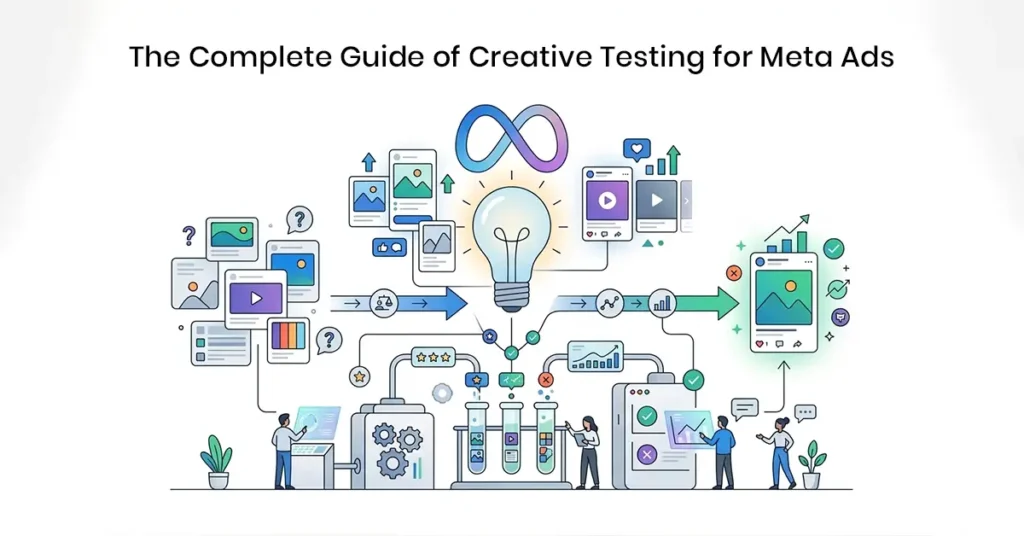
A practical system can be broken into four stages: Concept, Variable, Scale and Refresh.
Concept: Start with genuinely different creative directions. Test price-led versus lifestyle-led, testimonial versus walkthrough, founder-led versus polished brand film, or feature-led versus outcome-led communication. The objective is to find which broad direction has potential.
Variable: Once a concept shows promise, test individual elements within it. If a property walkthrough is working, test different opening three seconds or headlines while keeping the rest relatively consistent. This gives you a better chance of understanding what caused the improvement.
Scale: Move proven creatives into the main campaign and give them enough budget to see how they perform at a larger level. Don’t assume that a creative that works at low spend will behave exactly the same when delivery increases. Watch cost per result, frequency and lead quality.
Refresh: Every creative eventually loses effectiveness. Audience fatigue, increasing frequency and changing market conditions can all affect performance. Don’t wait until the campaign is struggling to start making new ads. Keep testing while your current winners are still working.
A separate testing campaign with around 10–20% of the budget can be a practical starting point, depending on the account and conversion volume.
The testing setup matters as much as the creative itself.
If you’re testing creative, keep the audience and other major variables as consistent as possible. Otherwise, you won’t know whether the difference came from the creative or the audience.
Don’t test too many creatives at once either. Ten variations may sound thorough, but if the account doesn’t have enough conversion volume, the data gets divided across all of them. Three to five meaningful variations can often produce a cleaner read.
The testing period also needs some patience. Killing an ad after one or two days can lead to poor decisions, especially when conversion volume is low. Early delivery can be noisy, and weekday and weekend behaviour can differ.
For many campaigns, four to seven days can provide a useful initial view, but the right testing period depends on the account’s budget, conversion volume and buying cycle.
Real estate needs even more patience because a form submission is only the beginning of the process.
Imagine two ads.
One generates leads at ₹400 each. The other generates leads at ₹650.
The first looks better in the Meta report. But now look at what happens after the lead comes in.
If the ₹400 leads rarely answer calls while the ₹650 leads are much more likely to become site visits, the second creative may be more valuable to the business.
This is why real-estate creative testing should go beyond CPL. Depending on the campaign, you may need to look at qualified leads, sales conversations, site visits and eventually bookings.
The cheapest lead isn’t always the best lead.
Start every meaningful test with a hypothesis. It can be simple: “We believe a lifestyle-led opening will generate better-quality enquiries than a price-led opening because this project is positioned as a premium family home.”
Look at more than the final conversion number when analysing creative. For video, early engagement and retention can help explain why one version performs differently. If people leave immediately, the opening may be the problem. If they watch but don’t convert, the issue may be the message, offer or CTA.
Keep a record of every creative you test, including the ones that fail. A failed ad can still be useful if it tells you something about your audience. It also stops your team from unknowingly testing the same idea again months later.
And keep personal taste separate from performance. Brand quality matters, but once an ad is live, the market gets a vote.
Nine years in, Digital Tokri has managed more than 6,000 campaigns for over 300 clients, with a significant part of that work in real estate. Developers including Nirman, Namrata Group and Vasupujya have worked with the team over multiple years, with some relationships going back to 2018.
That experience has made one thing clear: in property marketing, the cheapest lead isn’t necessarily the most valuable one.
A campaign can generate hundreds of enquiries and still struggle to produce site visits. Another campaign may generate fewer leads but attract people who are much closer to making a buying decision.
That is why creative testing needs to look at the complete journey, from the ad and enquiry through to qualification and site visit. The objective is not simply to find the creative that produces the most leads. It is to understand which message attracts the right audience and moves them further toward a purchase.
Digital Tokri brings branding strategists, performance marketers, designers and content specialists into the same workflow, allowing campaign learnings to feed directly into the next round of creative.
If your Meta campaigns are still being evaluated mainly through CPL and a monthly report, there may be more performance sitting inside your creative than you’re currently capturing.
A structured testing programme can help you understand which messages, formats and creative angles are working, while giving your team a clearer idea of what to make next.
Digital Tokri offers a free creative audit for businesses that want an outside view of their current Meta campaigns.
Call +91 808 083 6251 or visit digitaltokri.com to start a conversation with the team.
 Your Agency Celebrates These Metrics. We Don’t. »
© Digital Tokri (Ira Digital Services). All rights reserved.