You can have a well-planned Google Ads campaign, strong Meta creatives and a steady flow of organic traffic, but if your website is not built to convert that traffic, you can still end up with very few leads. This is one of the most overlooked problems in digital marketing. Businesses often focus heavily on getting people to their website but spend far less time looking at what happens once those people arrive.
Research from Google has consistently highlighted the importance of mobile page speed, while Google Analytics data can often reveal how quickly visitors leave a website and where they drop off. Even small improvements to the website experience can have a meaningful impact on conversions. In fact, Google has reported that as page load time increases from one to three seconds, the probability of a mobile visitor leaving increases by 32%.
A visitor may click an ad with genuine interest, visit your website and leave within a few seconds because the page is slow, the message is unclear or there is no obvious next step. The advertising campaign gets blamed, while the real problem sits on the website.
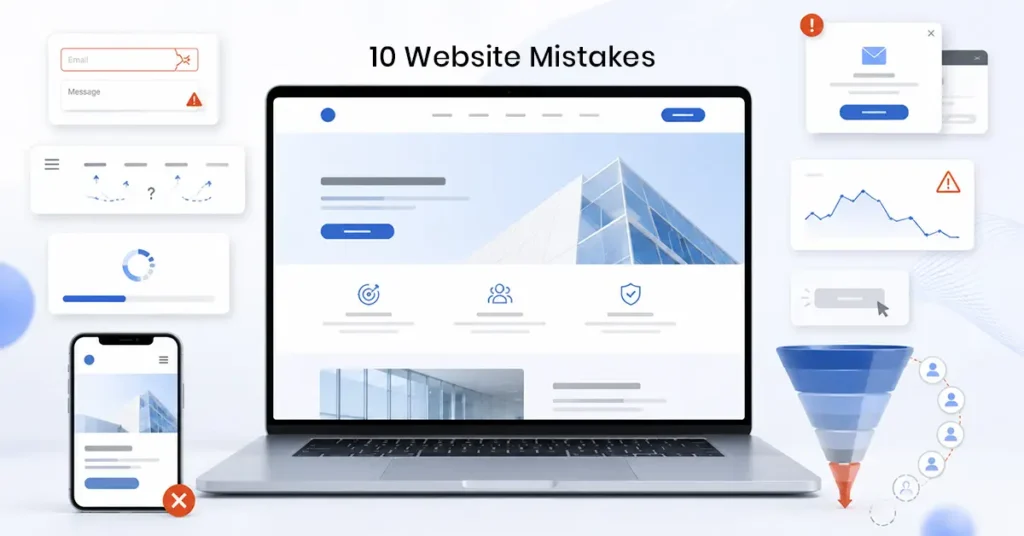
If your website is responsible for generating enquiries, these are some of the most common mistakes worth checking.
Website speed has a direct impact on user experience. When someone clicks an advertisement or finds your business through Google Search, they expect the page to load quickly. If it takes too long, they may simply move on to another website.
Large images, unnecessary plugins, excessive scripts, poor hosting and unoptimised code can all contribute to slow loading times. This can affect both your website conversion rate and SEO performance.
A useful starting point is to check your Core Web Vitals and look at:
Improving website speed does not always require rebuilding the entire website. Compressing images, removing unnecessary elements, improving hosting and optimising the site’s code can make a significant difference.
A visitor may be interested in your service but still leave because your website does not clearly tell them what to do next. This is where a strong call to action matters.
Generic buttons such as “Submit” or “Click Here” do not communicate much. Depending on your business, a more useful CTA could be “Get a Free Consultation”, “Request Pricing”, “Book a Site Visit” or “Talk to an Expert”.
Your CTA should match the visitor’s intent and make the next step feel simple. A website designed for lead generation should not leave visitors guessing about how to contact you.
A simple CTA audit can ask three questions:
A website should make information easy to find. If visitors have to click through multiple pages just to understand what you offer or find your contact details, there is a good chance they will leave.
This is particularly important for businesses with multiple services or products. Your navigation should prioritise the information customers are most likely to look for. Services, products, locations, information and contact options should be easy to access.
Good website design is not about adding more options. It is about creating a clear path for the visitor.
A simple rule is useful here: if an important page takes too many clicks to reach, simplify the journey.
A website that looks good on a desktop may still provide a poor experience on mobile. Small text, difficult-to-click buttons, poorly formatted images and complicated forms can all affect conversions.
Mobile optimisation should be considered across the entire customer journey, especially for businesses running Google Ads and Meta Ads where a significant portion of traffic can come from smartphones.
Test your important pages on actual mobile devices. Check how quickly they load, whether the content is easy to read and how easily someone can complete an enquiry form or contact your business.
Pay particular attention to:
Getting a visitor to share their phone number or email address requires a certain level of trust. If your website does not provide enough proof that your business is credible, potential customers may hesitate to enquire.
Testimonials, customer reviews, case studies, certifications, awards, client logos and years of experience can all help establish credibility. The right trust signals will depend on your industry, but the principle remains the same: give visitors enough information to feel confident about taking the next step.
For a lead generation website, ask yourself: If a first-time visitor knows nothing about my business, what on this page would make them trust me?
If the answer is “not much”, you have a clear area to improve.
Lead forms are important, but making them unnecessarily long can hurt your conversion rate. Asking for information that is not required at the first stage can create friction and discourage people from completing the form.
Think about what your sales team actually needs to start a conversation. In many cases, a name, phone number and email address may be enough.
You can always collect additional information during the follow-up process. The purpose of the first form is to make it easy for an interested visitor to raise their hand.
A useful approach is to compare:
Form fields → Form starts → Form completions → Qualified leads
This gives you a much clearer picture than simply counting how many people visited the page.
One of the common mistakes in paid advertising is focusing so much on the ad that the landing page gets overlooked.
For example, someone searching for “3 BHK flats in Pune” should not click an ad and land on a generic homepage where they have to search for the relevant project. The page should immediately provide information related to their search.
The same principle applies to service businesses. If your Google Ads campaign promotes SEO services, the visitor should ideally land on a dedicated SEO page rather than a generic services page.
Relevant landing pages create a more consistent journey from keyword to ad to website and can improve both user experience and lead generation.
Many business websites begin with statements such as “We are a leading company” or “We have over 20 years of experience.” While credibility matters, your website should not spend all its time talking about the business.
Visitors are more interested in what you can do for them. What problem do you solve? What makes your offering useful? What can they expect? Why should they choose you over another option?
Your experience and achievements should support the story, not become the entire story.
A good test is to read your homepage and count how often you say “we” versus how often you explain the customer’s problem, need or outcome. If the page is heavily focused on the company, the messaging probably needs work.
If someone has decided they want to speak to you, contacting your business should be one of the easiest things they can do.
Yet some websites hide their phone number, bury the contact page or make visitors complete a complicated form before they can get basic information.
Keep important contact options visible. Depending on your business, this could include a phone number, WhatsApp option, enquiry form or booking button. On mobile, a sticky CTA can make it even easier for visitors to take action.
Your analytics should also tell you whether people are actually using these options. Track:
Traffic is useful. Tracked actions are more useful.
Your homepage is designed to introduce your overall business. It is not necessarily the right destination for every marketing campaign.
Different audiences have different needs. A person looking for a specific service should see information about that service. Someone searching for a particular property should see that property. Someone responding to a specific offer should see the details of that offer.
Dedicated landing pages allow you to align the page content with the campaign, audience and search intent. This is an important part of both landing page optimization and website conversion optimization.
Instead of sending every campaign to the homepage, create pages based on:
Getting someone to click an ad is only the beginning. The real opportunity comes after the click.
Your advertising, landing pages and website need to work together. If the ad promises one thing and the landing page delivers something completely different, visitors lose confidence. If the website is difficult to navigate or the CTA is unclear, potential leads can disappear even when your advertising is reaching the right audience.
This is why lead generation should not be looked at only from an advertising perspective. Your website plays a major role in turning traffic into enquiries.
Before increasing your advertising budget, look at your website analytics and understand where visitors are dropping off. Review your landing page conversion rate, mobile performance, form completion rate and traffic sources.
Sometimes the biggest improvement does not come from getting more traffic. It comes from making better use of the traffic you already have.
A successful digital marketing campaign does not end when someone clicks your ad. It ends when that visitor takes the action you want them to take.
Your website needs to load quickly, communicate clearly, build trust and make the next step easy. When these basics are right, your advertising and SEO efforts have a much better chance of producing actual business results.
Before spending more on Google Ads or Meta Ads, look at what happens after the click. Find the pages where visitors leave, the forms they abandon and the CTAs they ignore. Those numbers can tell you more about your lead generation problem than traffic volume alone.
Getting the click is only half the job. Your website has to earn the lead.
© Digital Tokri (Ira Digital Services). All rights reserved.
 Back
Back